Stinky Old Books
1870s Paroissien Romain: First Communion, A. A. Initials
1870s Paroissien Romain: First Communion, A. A. Initials
Couldn't load pickup availability
Paroissien Romain printed by Louis-Ernest Cornillac, Châtillon-sur-Seine, France. French and Latin languages. Publication c. 1870-1873 (Text carries the 1854 ecclesiastical approbation; features a movable feast liturgical calendar spanning 1869–1895, and an inscription dated 1873).
This charming Roman Parishioner prayer book was given as a customized First Communion gift 153 years ago to Auguste Angély by Césarine Creuxter, who was likely his godmother.
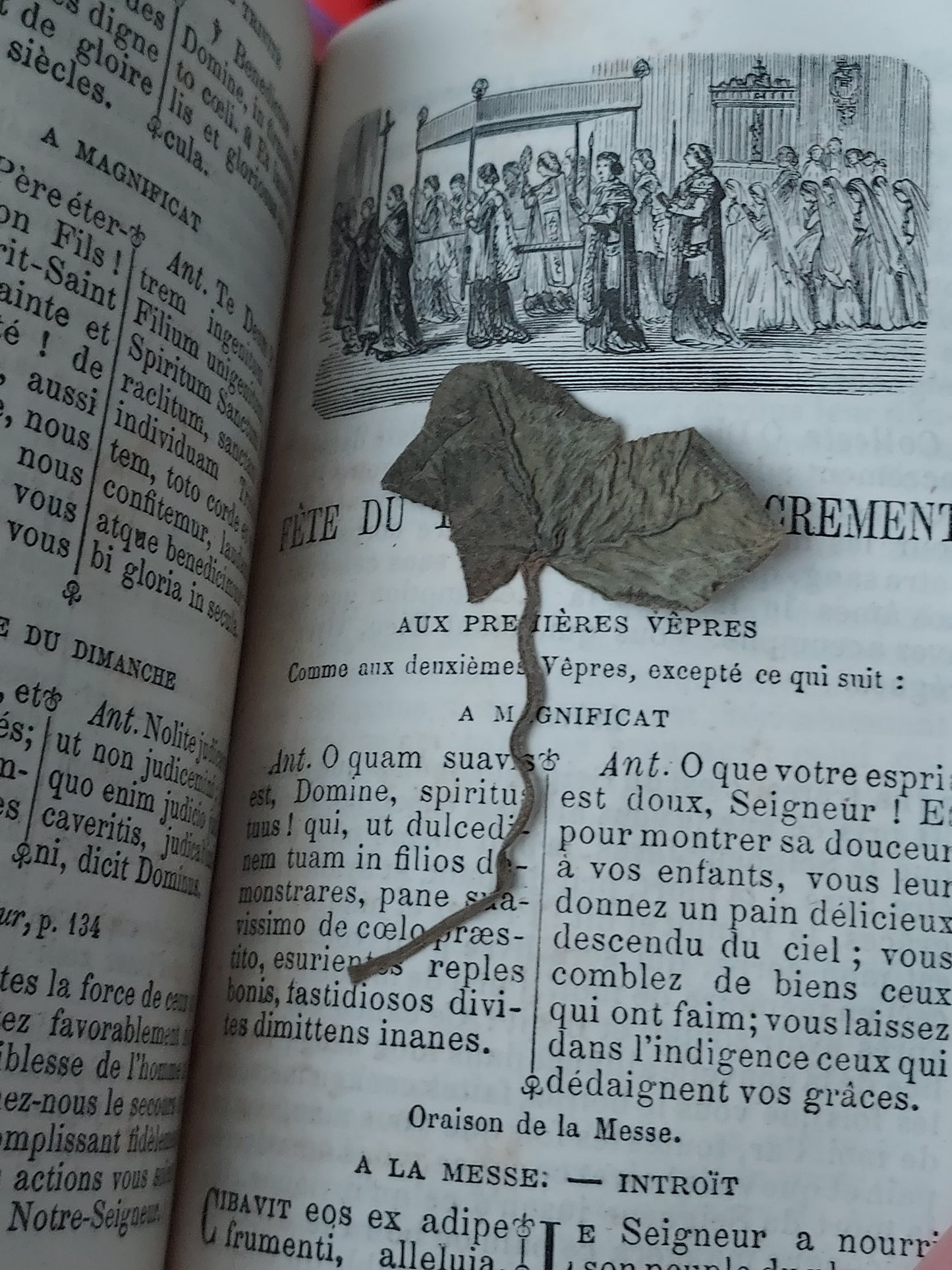
It's bound in full red leather, the cover is adorned with an intricate leaf motif and A.A. initials, 4 raised bands on the spine, decorative double metal clasp closure in a gold-tone, all page edges are gold gilt, ivory endpapers stamped to mimic moiré silk, and black and white illustrations by Hercules Catenacci (illustrator), Édouard Deschamps (master wood-engraver), dried flower on page 270, dried clover on page 457, 704 pages.
85 mm W x 120 mm H
Inscription: Souvenir of First Communion, given to Auguste Angély, by Césarine Creuxter, Mai 1873
Additional Context: In 1870s Catholic France, the Première Communion (First Holy Communion) was a significant rite of passage, usually celebrated when a child was around 11 to 12 years old. Gifting a personalized Paroissien was a traditional present.
The ornate title page border features Christian iconography. There are Tetramorphs, symbolic winged creatures representing the Four Evangelists who wrote the Gospels:
- The Eagle (Top Left): Symbolizes St. John, representing his soaring theological vision.
- The Winged Man/Angel (Top Right): Symbolizes St. Matthew, focusing on Christ's human genealogy.
- The Winged Ox (Bottom Left): Symbolizes St. Luke, representing sacrifice and priestly service.
- The Winged Lion (Bottom Right): Symbolizes St. Mark, representing royalty and power.