Stinky Old Books
1902 Le Nouveau Testament & Prayer Card | Hand-Illuminated, Stamped by L. Angeli
1902 Le Nouveau Testament & Prayer Card | Hand-Illuminated, Stamped by L. Angeli
Impossible de charger la disponibilité du service de retrait
Le Nouveau Testament, by the prominent French theologian and Sulpician priest Louis-Claude Fillion. Printed by Letouzey, Paris, France. Bound and stamped by Luigi Angeli. Published 1902.
This is a masterful, museum-quality binding by Luigi Angeli, an elite turn-of-the-century Italian bookbinder.
Operating in the late 19th and early 20th centuries, Luigi Angeli was highly celebrated for his intricate Renaissance and Baroque revival bindings. He routinely combined precise dentelle (lace-like) gold-leaf work with heavy blind-stamping.
This edition features both of those techniques. It's a full premium chestnut-brown calfskin leather exhibition binding. It has symmetrical Italian Renaissance gold-leaf scrollwork and filigree across the front and back covers. The covers include a heraldic coat of arms with a helmet at the center.
While a completely closed steel visor usually designates a standard gentleman or lower patrician, an open visor displaying internal bars is traditionally reserved for titled nobility, specifically Knights (Cavalieri), Baronets, or Peers. These details highlight a family's distinguished noble background and provide insight into the status of the original owners.
It has 5 raised bands at the spine; all edges are gold-gilt and gauffered with a repeating 6-petaled floral stamp. There are two metal clasps connected to decorated leather straps that are fully intact and functional. The endpapers are marbled, the turn-ins feature gold dentelle and an L. Angeli bookbinder's stamp, and the frontispiece is hand-illuminated with vibrant gold, red, black, and blue paint.
This book contains Les Saints Évangiles et les Actes des Apôtres (The Holy Gospels and the Acts of the Apostles). L.-Cl. Fillion was a highly regarded priest of Saint-Sulpice and a Professor of Holy Scripture at the prestigious Catholic Institute of Paris (Institut catholique de Paris). His translations were celebrated for balancing rigorous archaeological scholarship with traditional theology.
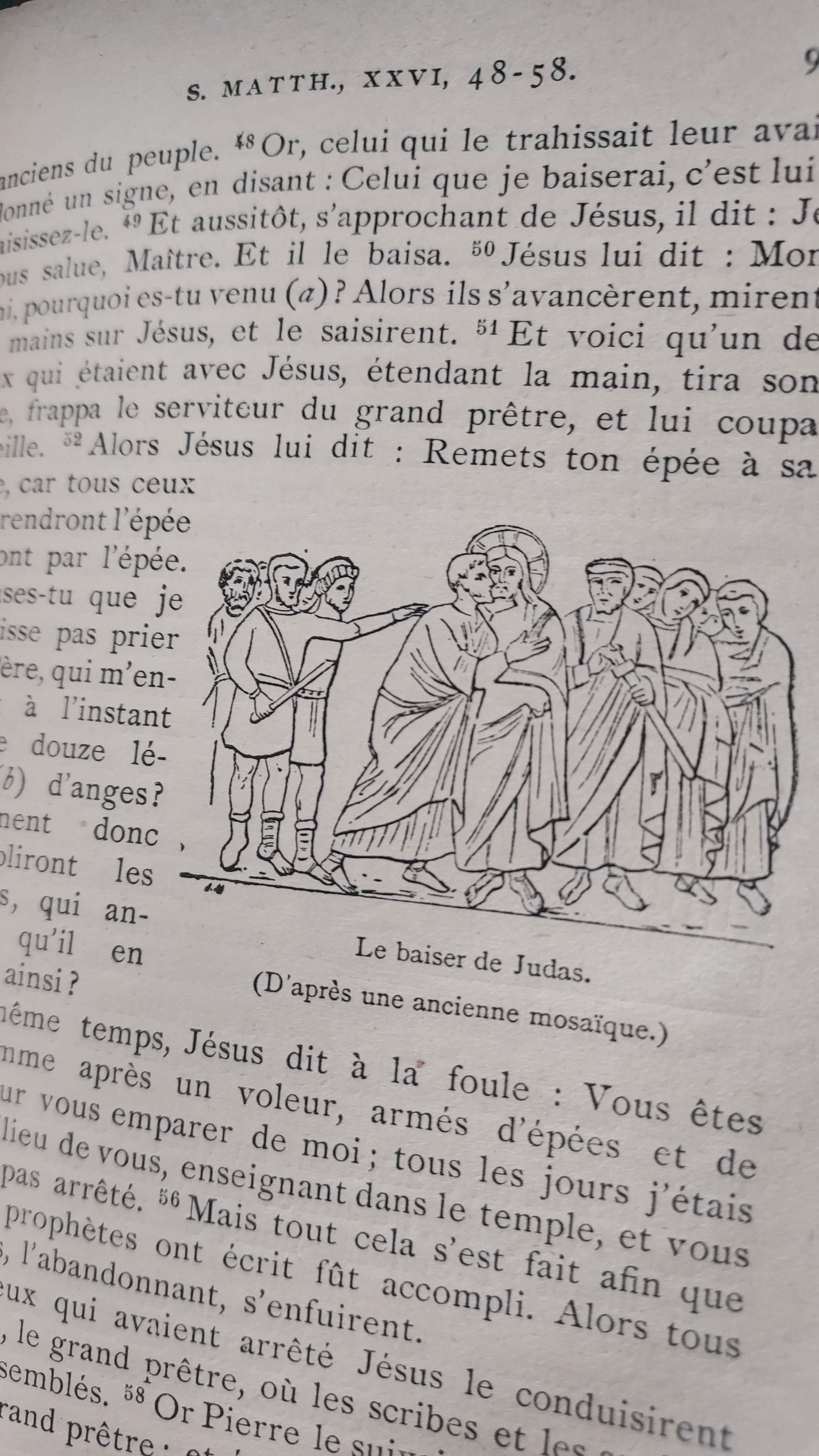
It is an annotated translation adorned with numerous engravings copied from ancient documents and displayed alongside the text throughout.
It also comes with an original hand-illuminated prayer card. The prayer card features a spiritual poem written by Saint Teresa of Ávila (1515–1582), known historically as St. Teresa’s Bookmark. Written in beautiful French Gothic calligraphy, it translates to:
Let nothing trouble you. Let nothing frighten you. Everything passes! God never changes. Patience obtains all things. Whoever possesses God lacks nothing.
The banner at the top of the bookmark reads "Signet de Ste Thérèse" (Bookmark of St. Teresa). Above it sits her famous personal spiritual motto on a ribbon scroll: "Ou souffrir ou mourir" (Either to suffer or to die). The powerful words are framed by flowing florals in vibrant colors.
French Language, 471 pages.